


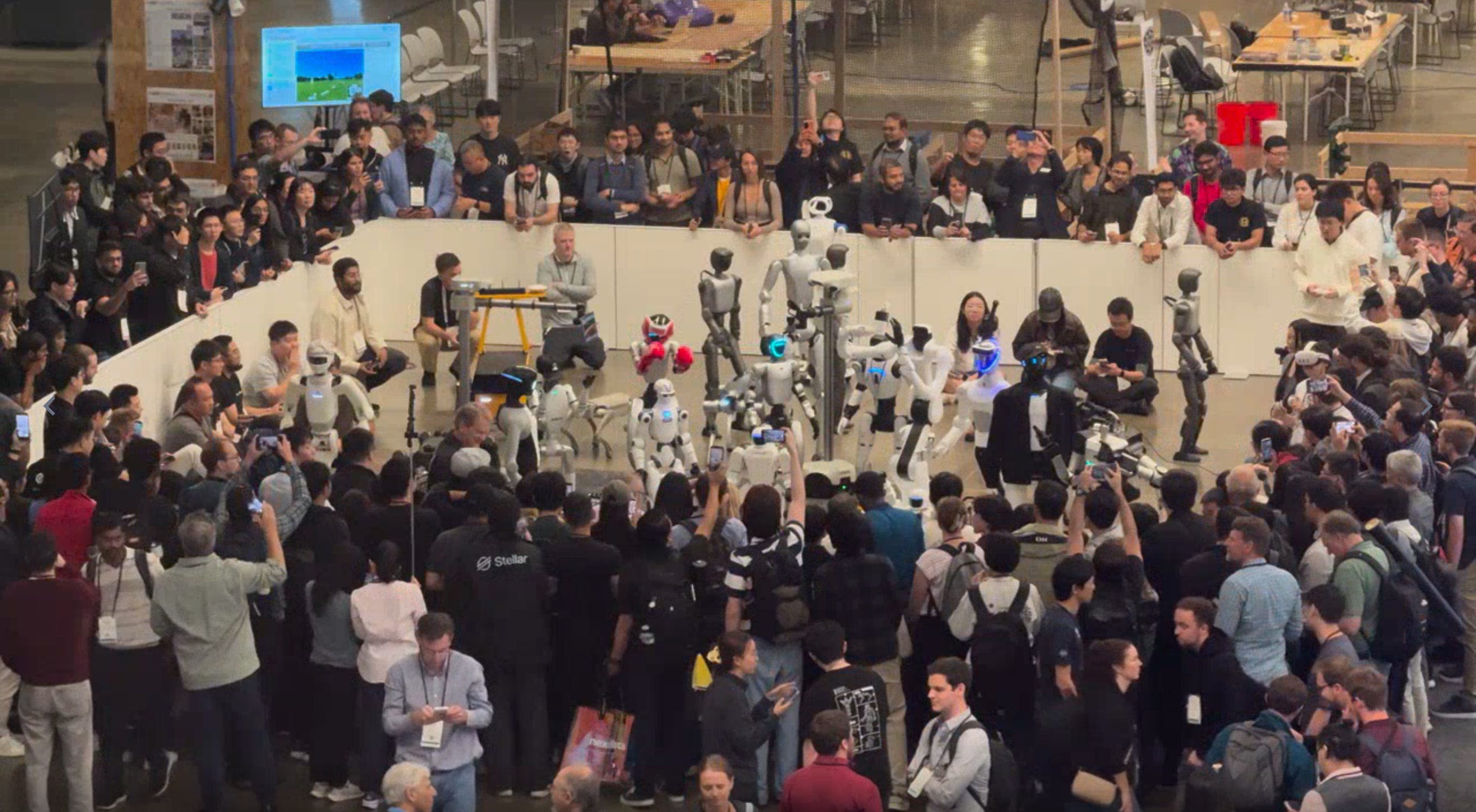
At IROS this year, I watched a Rysen gripper hold 10 kilograms while the people at the booth happily let me whack it with a hammer. That willingness to let visitors put hardware through its paces captured some of what made the expo so exciting. There were new robots, tactile sensors, robust grippers, and plenty of opportunities to ask how they worked. I left wanting to build things.
I also left thinking about the debate over whether robots should be generalists or specialists. In his account of the debate, Matt Mason describes a framing in which generalists can do everything humans can do, while specialists reliably perform particular tasks. He makes the case for machines whose capabilities extend into parts of the world that human bodies cannot readily reach.
That framing leaves me wanting a more useful way to talk about generality. I care about what else we can do with a robot after making the initial investment. How much does it cost to adapt it to another problem? How much of the hardware, software, and collected experience carries over? Can someone discover a useful capability that we never explicitly modeled when building it?
Consider a car. It can transport people, pull something out of a ditch, provide shelter, or become a marketing icon. These uses ask different things of the same vehicle, often with little additional investment in the vehicle itself. We keep finding purposes for the capabilities and physical properties already available to us.
An excavator has a distinctive form and a limited workspace, but those constraints still leave room for many kinds of useful work (when driven by a trained human). A forklift can serve businesses handling very different goods. Human operators supply much of that flexibility today. For robotics, the opportunity is to make more of those uses accessible through software, learned behavior, and interfaces that are inexpensive to adapt.
This is the kind of generality I want us to pursue. A robot can have physical strengths and limitations while supporting a growing range of applications. It can require training for a new task. It can use tools. Its usefulness can expand as people learn what to ask of it.
We could build bimanual manipulators on wheels, centaurs, snake robots, tractors, or machines with forms we have barely explored. Visiting Howie Choset’s lab and seeing the snake robots was a reminder of how much room there is to work with. The shape of a robot opens some possibilities and closes others. We have considerable agency in choosing which possibilities to explore.
The software question matters just as much. If every new application requires rebuilding the entire control and learning pipeline, adapting a machine remains expensive even when its hardware is suitable. We should ask which parts of that work can become reusable.
That is one reason I find work such as Success-Guided Sampling, or SGS, interesting. The paper studies a training approach across quadruped locomotion and contact-rich assembly, directing practice toward configurations near the policy’s current capabilities. It also demonstrates transfer of assembly policies from simulation to real hardware. There is still substantial engineering involved, but a training method that works across different tasks and embodiments is the sort of reusable investment I want to see.
I am also excited about using tools like Astra to help construct and revise simulated scenes through an iterative conversation. I want to describe an environment, inspect what was built, refine the specification, and try an idea. Reducing the effort required to build an experiment gives us more opportunities to discover whether a platform can do something useful.
The details still matter. We need to understand the action space, the controller interpreting those actions, and the information available to the policy. The relative-pose representations used in UMI are an example of how those choices can make learning more transferable. These are concrete engineering decisions that builders can investigate and improve.
At IROS, I saw hardware that made me excited about how quickly we can experiment. My hope is that more people take that as an invitation. Pick a problem you care about. Choose or build a machine with useful physical capabilities. Use the available software to try something, then carry what you learn into the next application.
I want a future full of colorful, interesting robots, with people discovering uses their designers never anticipated. We have more ways to participate in building that future, and I would like us to explore them.