


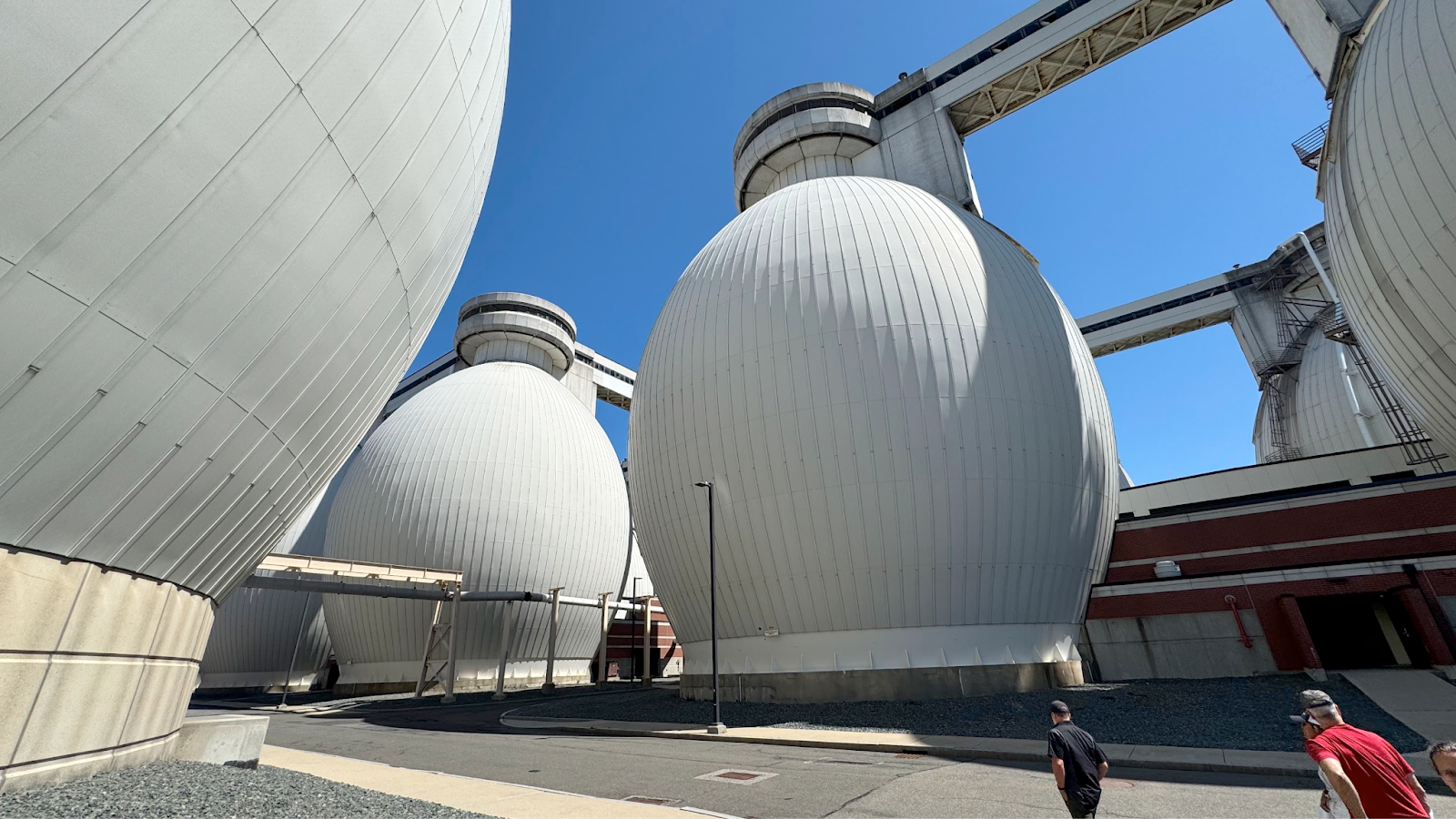
The Deer Island Wastewater Treatment Plant is something that many East Coast Massachusetts residents take for granted. But as Stefie and I toured the massive, $3.8 billion facility, it became clear that this is an engineering marvel. Some editorializing: I had never seen Stefie so excited about a field trip before, even when the smell got a little too unbearable for me. And honestly, it’s hard not to get excited when you’re staring at problems that perfectly illustrate where effective use of engineering principles has solved significant societal challenges.
The Scale of What We’re Missing
Deer Island processes an average of 360 million gallons of wastewater daily for the greater Boston area, with peaks reaching 1.3 billion gallons per day. The facility spans 365 acres and serves 43 communities, representing about 34 percent of Massachusetts’ total population for sewage treatment services. Walking through the primary treatment tanks, secondary clarifiers, and the impressive egg-shaped digesters, you’re confronted with the sheer scale of infrastructure that keeps modern society functioning and struck by how much of it still relies on manual inspection and maintenance.
The plant’s architecture is breathtaking. The twelve egg-shaped anaerobic digesters, each 90 feet in diameter and 110 feet tall, dominate the skyline and hold 3 million gallons apiece. These structures alone cost hundreds of millions to construct and require constant monitoring to maintain optimal conditions for breaking down organic matter and producing methane that powers 20% of the plant. Yet much of the inspection work is still done by humans, who climb into confined spaces, work in hazardous environments, and manually check equipment. Our tour guides explained the costly process of emptying a digester of sludge and refilling it with water. People enter on rafts to inspect and clean the inside. (We were asked repeatedly to avoid using flushable wipes. Flushable wipes are not flushable!)
The engineering complexity is staggering. The plant uses 48 primary clarifiers, each 186 feet long by 41 feet wide by 24 feet deep, with “stacked” settling surfaces at mid-depth to double the settling capacity within the tight space confines of Deer Island. Over one hundred tons of pure oxygen are manufactured each day at the facility’s cryogenic plant to support the biological treatment process, raising pollution removal to over 85%.
Beyond the impressive scale of waste processing, Deer Island became an unexpected frontline in pandemic surveillance during COVID-19. MWRA partnered with Cambridge-based Biobot Analytics to track wastewater at Deer Island for COVID-19 infection indicators, with samples analyzed daily. The facility processes wastewater from 43 communities across eastern Massachusetts, which provides a comprehensive view of viral spread in the Greater Boston area.
What made this approach particularly valuable was that wastewater surveillance could detect virus levels several days before positive test numbers started to increase, serving as an early warning system for community outbreaks. Unlike traditional case counts, COVID-19 data from sewage measured virus prevalence in the community at large, including among people who didn’t have symptoms and didn’t get tested, since the virus they shed through bodily waste contributes to levels found in sewage. The plant’s COVID-19 traces provide public health officials with critical data for policy decisions.
The Plastic Problem
One of the most striking observations during our tour was the amount of plastic waste that accumulates at various stages of the treatment process. Despite screens and filters, plastic debris, everything from bottle caps to grocery bags, constantly surfaces in the treatment tanks. Workers currently remove this material manually, a labor-intensive process.


This isn’t just about automation for efficiency’s sake. This is about creating solutions where none currently exist at scale. The plastic removal problem at wastewater facilities represents a perfect example of an opportunity to solve problems with automation that humans have struggled with.
The trip opened our eyes to the many potential applications of robotics to automate processes that are heavily manual today. One of our colleagues, Howie Choset, co-founded a new venture, Pipe Force AI. Instead of building another general-purpose robot, Pipe Force AI is explicitly focused on robotic inspection of storm sewer pipes. Storm sewers are critical infrastructure that require regular inspection to prevent flooding and environmental damage, yet current inspection methods are dull, dirty, and dangerous.
While we talk a lot about the Bitter Lesson on our blog, the importance of a general method that applies to a lot of different problems remains applicable. Inspecting pipes in municipalities at 900 ft/hr, Pipe Force AI is developing technology that could aid in inspecting miles of pipe leading into the wastewater treatment plant.
The Infrastructure Opportunity
What excites me most about visiting places like Deer Island is realizing how much critical infrastructure operates with minimal automation. Water treatment, wastewater processing, and stormwater management offer us, as roboticists, opportunities to find new ways to motivate our research and explore new possibilities.
These aren’t glamorous applications: Deer Island is dirty and dangerous (but definitely not dull!). There are no viral videos of robots cleaning grease from clarifier tanks or inspecting the inside of digester vessels. But these applications represent precisely the kinds of problems where robotics can create genuine value: capabilities that humans haven’t yet unlocked.
A Monument to Engineering Excellence
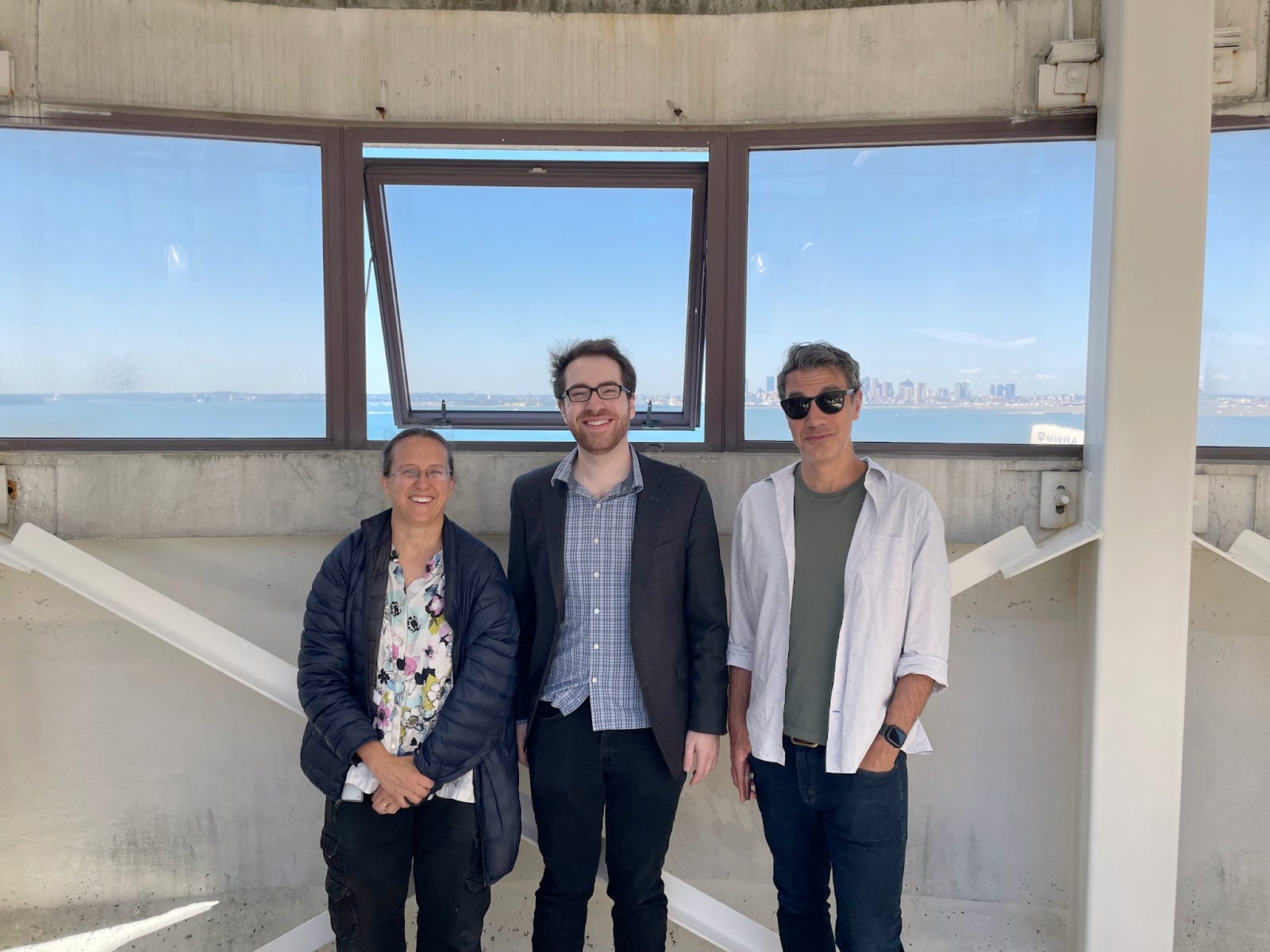
The smells hit you in waves as you walk through different sections of the facility. Air scrubbers and carbon adsorbers continuously remove odors and volatile organic compounds from treatment process “off-gases,” covering primary and secondary treatment facilities, sludge processing, and grit removal. Still, the primary clarifiers, where gravity separates sludge and scum from incoming wastewater, are where the tour gets most aromatic. Despite the tour guides’ repeated reminders about the air permit, our noses kept reminding us that waste is managed at the facility.
The facility’s transformation of Boston Harbor represents one of America’s greatest environmental success stories. Before the new plant opened in 2000, the system had combined sewer overflows an average of 60 days per year, with about 10 billion gallons per year of untreated sewage flowing into Boston Harbor. By the 1960s, Boston Harbor was covered in a deep sludge resembling molasses.
The engineering challenges were immense. Wastewater from the 43 communities reaches the plant via four underground tunnels, then is pumped about 150 feet to the treatment facilities. Gravel from these tunnels was used to line the bases of the sludge digesters. The project was tragically marked by the deaths of two divers working in the narrowing anoxic outfall tunnel ten miles from land during construction of the 9.5-mile underwater discharge system.
Even today, the facility continues to face operational challenges. As recently as August 2019, Deer Island had to run on backup power for several days at a cost of about $30,000 per day during installation of a new $115 million power cable across Boston Harbor. The original cable had been installed too shallowly three decades earlier, violating federal permits and eventually blocking harbor dredging operations.
Standing among those iconic egg-shaped digesters, watching the complex choreography of pumps, clarifiers, and biological treatment systems processing hundreds of millions of gallons daily, you witness not just waste treatment but a monument to what ambitious engineering can accomplish. The methane captured from digestion powers boilers that heat the entire facility and drive steam turbine generators producing an average of 3 megawatts of electricity. Digested sludge leaves the island through the Inter-Island Tunnel to be processed into fertilizer at the Fore River facility - Bay State Fertilizer!
The numbers are staggering, the engineering is brilliant, and the environmental impact is transformative. If the plant stopped processing waste, our toilets would start backing up with sewage within a day. Deer Island and projects like it transformed Boston Harbor from the dystopia in Neil Stephenson’s book Zodiac to the idyllic, beautiful ecosystem and working harbor it is today. But what struck us most during our tour was how much of this critical infrastructure still relies on manual processes that could benefit from robotic automation. From plastic removal to equipment inspection, Deer Island represents not just an engineering triumph but a window into the automation opportunities that await us in the infrastructure we depend on every day.