


At ICRA this year, I got asked whether it would be difficult to have a robot put a blood pressure cuff on a person. I am absolutely certain we could do this on a mannequin; probably there are already demos. But can we do it on a vulnerable person, with enough reliability? The honest answer starts with the fact that governs every physical robot: if a robot is strong enough to help, it’s also strong enough to hurt.
The appendix of the ISO co-bot standard references a study about how many newtons of force can be exerted on various parts of the human body before pain onset - eyes, hands, knees, etc. This information is important because a “co-bot” does not know where the person is. Instead, the co-bot must be safe regardless of the person’s location by promising not to exert enough force on the person to hurt them. This means that co-bots, when operating in co-bot mode, are very slow and very weak. If a robot has enough strength to open a door, by definition it also has enough strength to hurt a person. And many of our robots have far more strength than that.
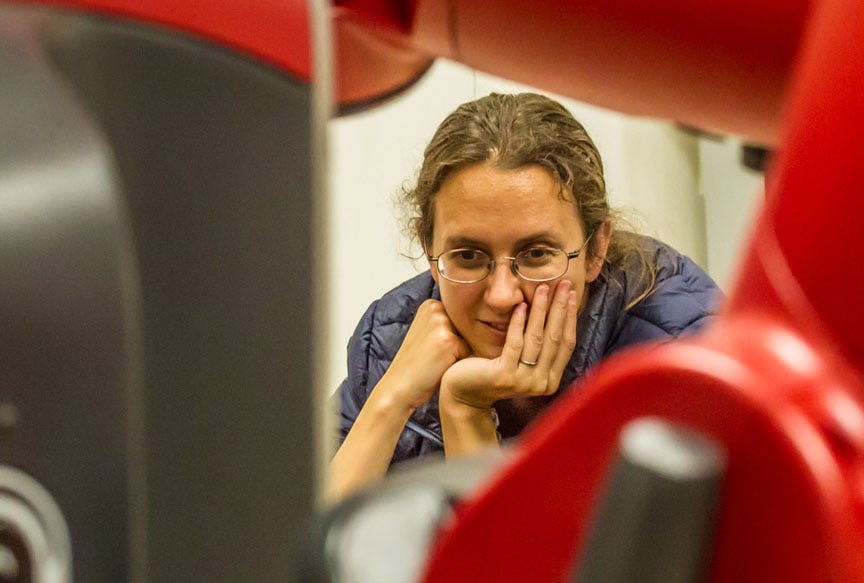
So can a co-bot put the cuff on? It depends on whether a robot constrained to those force limits is even strong enough to work the cuff around a person’s arm. And there is a catch buried in the standard: the ISO force values are the 75th percentile from the pain study. The person whose blood pressure is being taken may be far weaker and more vulnerable than that, which means we would probably need an even more conservative co-bot mode than the one the standard defines.
The most important method we use to keep people safe from robots is space. Don’t let the person get close. If the person gets close anyway, stop the robot. Safety LIDAR, light curtains, and metal cages with door alarms are all built around this doctrine.
I consulted for a robotics startup where I worked on their safety concept. Originally, we thought we could produce a safety-certified system where people work in close proximity with big, fast, strong robots by moving the robot out of their way. We were wrong. Moving the robot wasn’t the problem. The problem was the people. We could use a multi-camera perception system to detect where a person was right now. But people are fast, so knowing where they are now doesn’t help if they have moved their arm somewhere else by the time the robot has responded. By the time we worked out the math for how fast they could move, how fast the camera system needed to be, and how fast the robot had to respond, we basically got that the robot had to slow down or stop whenever the person got close.
And everything so far assumes the robot is already next to the person. Getting there is its own safety problem: how does the robot get to the person? If it’s a humanoid then we need to have a safety certified way to ensure the robot isn’t going to fall down and hurt the person. (Boston Dynamics recommends people stay 2m away from the Spot robot, and that is a quadruped!) If it’s not a humanoid, balance is still a concern. By the time you have enough weight, up high, to have two arms and a sensor payload, you almost have to worry about balance. Rainbow Robotics made a wheeled bimanual mobile manipulator, and I’ve heard several stories about it falling down.
Which brings me back to the blood pressure cuff. The tasks we most want robots to do for people, dressing them, steadying them, checking their blood pressure, are exactly the tasks the separation doctrine forbids. Every certified safety tool we have amounts to keeping the robot away from you. Until we invent something better than distance, the robot’s answer to our most intimate requests will be the same one we sometimes give each other: I need space.
I agree with you, I am sure we can do a nice demo in a friendly situation and with collaborative humans, but for the “general” solution we need robots able to anticipate the effect of their actions and of the humans. This is still far away and GenAI does not solve it.
Interesting take, i wonder if we would ever get to the point of being able to guarantee safety in human interaction with robots say in the next 15 years.