


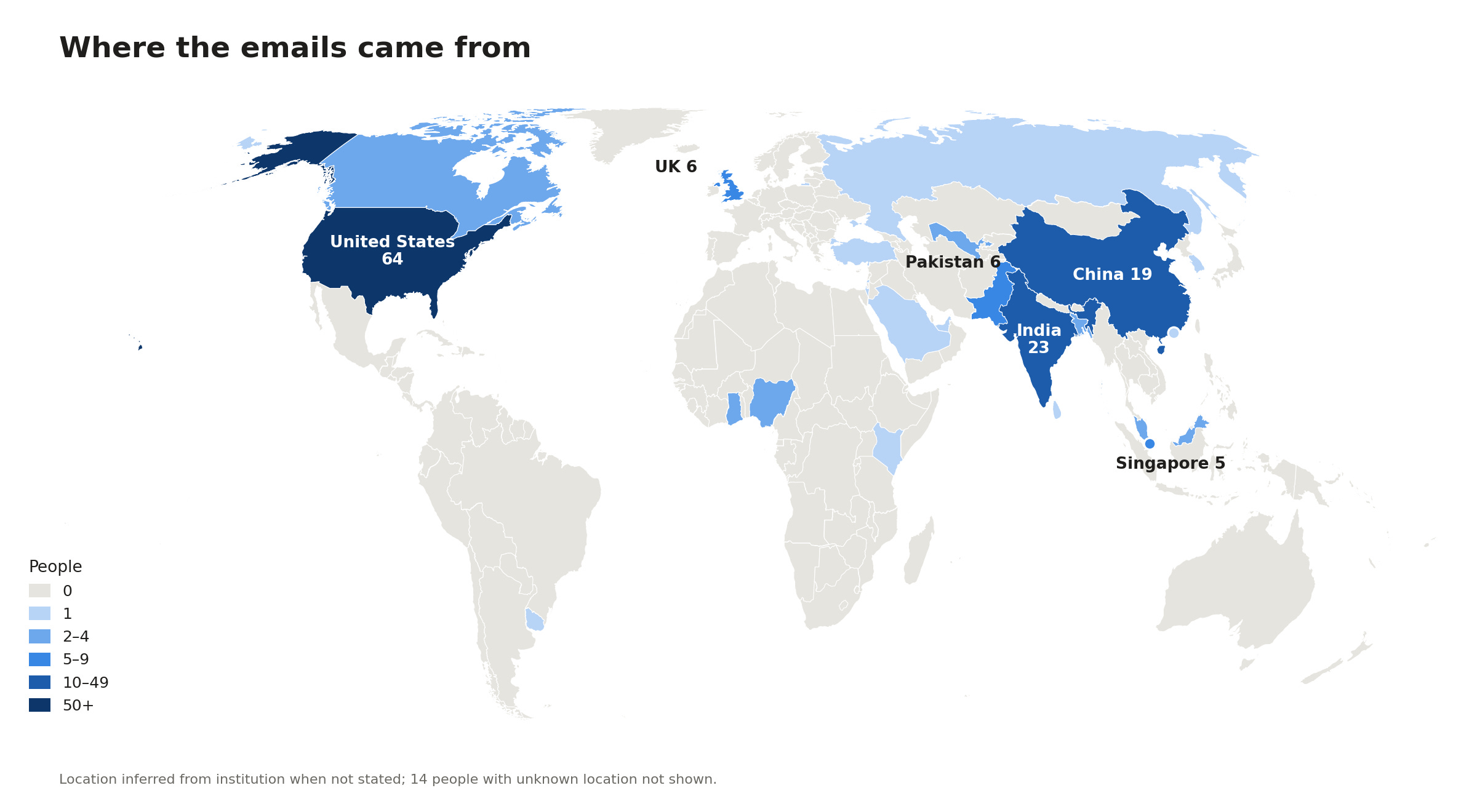
This year, 163 people from 22 countries, including China, India, Pakistan, the UK, Singapore, Bangladesh, Nigeria, Ghana, and Sri Lanka, wrote to me asking to do research in my lab: 74 prospective Ph.D. students, 32 high schoolers, and 57 undergrads, master’s students, postdocs, and others. October alone brought 42. More than four out of five named a specific paper of mine. The high schoolers were the most prepared: 31 of 32 did.
This message is to all of you. I want to acknowledge the time and effort you put into reaching out. (And for those of you that used AI and blasted emails to 1000 faculty, well, I guess I get it.) Especially with the actions of the current administration, I appreciate that you want to study in the United States. I can’t reply to all of you individually, but with AI I can finally aggregate all of these in one place and try to extract some general themes and advice for you.
Products of the University. My advisor Nick Roy says, “The products of the university are knowledge and people.” Knowledge in the form of new science, new information about the world. In robotics, make the robot do something it couldn’t do before and explain why. And people, who know things, and who know how to do things. In robotics, a Ph.D. is not important in itself. It is important because it is correlated with the thing we really care about: someone who spent a long time sitting next to the robot, making it do interesting things. Sitting next to a robot, making it do interesting things is something many of you can do without actually being at the university. Robots like our Duckiedrone or Hugging Face’s SO-101 don’t cost too much, and some come with lots of online resources, and AI makes that more accessible than ever.
Invest time at compound interest. Many students come to my office and tell me about the two, three or even four research projects they are working on, all at the same time. One of the pieces of advice I give out most frequently is to focus your effort on one project: one research project should be getting 80% to 90% of your focus. It’s okay to have others on the back burner, and as one gets done or submitted, the one with focus will shift. The reason for this is that the amount of time you spend on a project compounds: each hour on one research project is more productive and more valuable, on average, than the previous hour. As you understand the literature better, create more baselines, and think about things more deeply, you are more productive for each unit of time. If you spread this effort across many projects, you are spending most of your time in the ‘lower productivity’ part of the curve. If you focus on one, you can ride the curve up to achieve amazing results. Many students get stuck pursuing too many projects because they are not sure which one is most promising, so they delay focusing and try to move them all forward. This is a mistake: if you are not sure which one to focus on, just pick one. After you focus on it a while, you will be in a better position to evaluate its potential - in general and as a project for you. Then you can continue that one or pick a different one to focus on. Do this at the level of weeks or months.
Community, not Pedagogy. 3Blue1Brown has videos on a wide variety of technical topics. Somewhere on the Internet is some video that is better than almost any lecture I can produce. You aren’t at Brown for the lectures. You are there for the people. A robotics lab is much, much more than the robots: it is a group of people who support each other, inspire each other, and create a setting that is more than the sum of its parts. It is for this reason that one of my responses to AI is to increase the human contact in my class: my students are in groups, working on group projects, and we do oral grading so that even the process of grading is an interaction between student and course staff. Most people do better when working with others, rather than in isolation. Hillary Rettig says you need a mentor for every aspect of yourself that’s important. So don’t wait: find a community where you are right now: in your high school, in your undergraduate institution, in your neighborhood.
Don’t Worry. This advice is prescriptive, not descriptive. It is natural to worry, and we are very good at it. (Believe me, I know, I struggle with anxiety!) However, worry generally does not help you reach your goals. Ruminating on mistakes in the past or worrying about what might happen in the future takes your focus away from the only thing you can control: right now. Right now, how can you do great research?
For students looking for Ph.D. programs: apply on Brown’s website, and I wrote a guide to writing a research statement. I’m not sure yet if I’m taking students this year, but emailing me more times won’t help or change the answer during the admissions process.
For high school students: I generally don’t take high school student researchers. Try to look for programs closer to home, at universities and colleges near you. In-person work is essential for any kind of engagement because it lets you participate in the lab community.
You are all amazing. Go find your robot and your people.