


One of the joys of my adult life is learning to ride horses. I recently started with a new instructor, and we have been focusing on contact: the connection between your hands and the horse’s mouth, mediated by the reins.
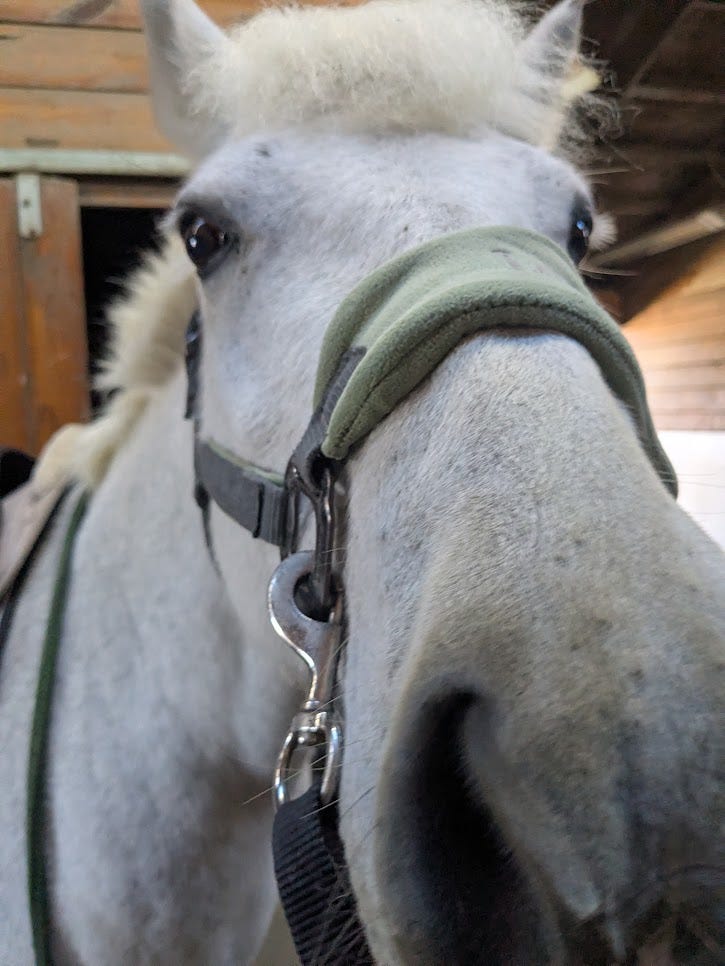
There is a lot of information online about contact and connection, which is the third level of the dressage training pyramid. (Rhythm, relaxation, contact, impulsion, straightness, collection.) What I took away from a lot of reading and videos and riding lessons was that at walk, your hands move back and forth to follow the horse’s mouth. At posting trot, your hands stay still (relative to the horse’s neck and head), because the horse’s head doesn’t move back and forth at that gait. To make this happen your elbows flex as you go up and down in the post. At canter, your hands move back and forth, same as walk, because the horse’s head is moving up at down. The goal of all of this is to have the pressure in the horse’s mouth remain constant unless you are giving an aid to ask the horse to bend or collect or slow down. Like holding hands with the horse’s mouth. So I tried to make this happen in my riding. It sort of looked right.
Then I started with my new instructor , Tom Davis. He gave me one rule: “Hang your elbows.” That’s it. If you relax your arms and hang their weight on your shoulders and the horse’s mouth (with a good seat etc.,), then the horse’s motion results in those three kinds of hand and arm motions at each gait. Automatically. You don’t have to think about it or try to make it happen; it is a downstream consequence of hanging your elbows. Of course in robotics we call this an underactuated control system with all of its many benefits: trading mechanical and electrical actuation for forces transmitted by the laws of physics. My favorite example of this is Aaron Dollar’s work on underactuated tendon-driven hands that passively comply with objects as they pick them up.
All of this made me think about AI. We are in this mode where people point out: AI can’t do thing X. Then, the big AI companies collect more data, design new RL training environments, spend more compute, and now AI can do X. Rinse repeat. And that’s not necessarily bad when this method - spending data and compute - results in AIs that really can do X, superhumanly well. I’ve spent a fair amount of time in the past few weeks being freaked out by this, not gonna lie.
But it’s also the case that the AIs doing X in this way are doing it very differently from how humans and animals do it. The human brain and the human genome does not take the same input the same way at the same scale as our AIs. Behaviorally we have found that even so AI can imitate many of the capabilities of humans and animals given sufficient data and compute. We are still exploring the capabilities and limitations of these imitations.. But I think another valid question to ask is: how are humans doing it? How are animals doing it? What elegant, explanatory underlying laws are we missing? And what behavioral differences do we observe between that way, and the data+compute way?